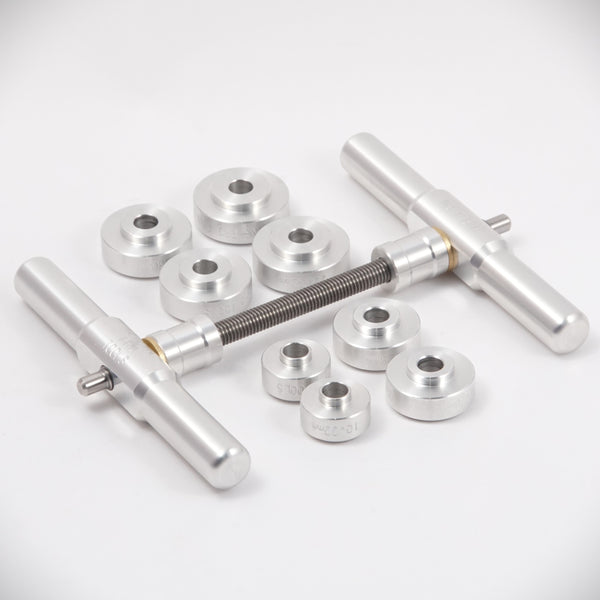


Bearing Puller Kit for Deviate Bikes
Regular price £33.15
Bearing puller tool kit for Deviate Cycles frame pivots - Claymore, Highlander, etc
Each kit is tailor made with all of the tool sizes required to remove all of the rear suspension pivot bearings from the selected frame .
Our Claymore and Highlander kit contains a wind-out blind bearing puller for the large 6808 bearing in the rocker, and a 15x7mm tap-out puller that is suitable for all the 3802 bearings in the all of the other suspension pivots. The tap-out puller can either be tapped out from behind using a hammer and suitable drift, or connected to our optional stainless steel slide hammer.
The reason for including a tap-out type puller instead of a second wind-out blind puller is that the two bearings installed in the chainstay have a curved carbon surface which prevents the wind-out tool's cup from sitting flat. It is possible to pack under the sides of the wind-out tool's cup to give a flat surface, but we wouldn't recommend this unless you are confident that you know what you are doing. If you do intend to use this technique, a 3802 wind-out blind pullers can be ordered here. There's a bit more info on that here. All of the other pivots give a good surface for the wind-out blind tool.
Note that this kit does not contain tools to remove the idler bearings or the large main pivot axle tube. They can be found here.
V2 Expanding Pullers
Our puller kits now use our V2 expanding puller. The V2 tool includes several important improvements:
- Grip has been greatly increased by including a ridge at the end of the tool to engage with the chamfer on the inside diameter of the bearing
- Tool durability has been increased by machining from 303 stainless steel (sizes over 20mm ID are 6082-T6 aluminium)
- The force required to tighten the tool has been reduced by refinding the tool profile
All of our tools are designed and precision machined by ourselves, here in the UK, and shipped internationally.

How to Use - Wind-Out Blind Puller
The wind-out blind puller (40x7mm inner collet, 54mm outer cup) is used to remove the large 6808 bearing in the Deviate rocker. It is not necessary to remove the oil seal that Deviate place outside each bearing beforehand, it will be remove with the bearing.

First, the expanding collet is inserted into the bearing and the nut tightened, causing the collet to grip the inside of the bearing:

Next, the 'cup' part of the tool is placed over the collet and a nut screwed onto the end of the threaded rod:

By inserting a hex key the expanding collet can be prevented from turning while the nut is tightened with a spanner. Tightening the nut draws the expanding collet into the cup:


How To: Tap-Out Puller
As well as the puller you will need a pair of spanners (or one spanner and a set of pliers), a hammer and a rod/drift/old bolt to tap the tool out with
- Insert the slitted circular end of the tool into the centre of the bearing. Grip the body of the tool across it's flats with a spanner or pliers and tighten the nut. This will expand the tool, gripping the bearing
- With the hub/frame supported on a bench or block of wood, the bearing and tool can be tapped out together by simply insert a rod/drift/old bolt into the other side of the bearing and tapping the end of the rod with a hammer
- Alternatively, the bearing and tool can be quickly and easily pulled out together using our optional stainless steel slide hammer
See our Manuals page to download the more detailed instruction sheets which come with our puller orders, now available in several languages.
Here's a quick demo of the tool's use on a hub:
Alternatively, instead of tapping out from the back, the tap-out puller can be used with our slide hammer:

Presses
See also our bearing presses, which are available in all of the same sizes and kits as our bearing pullers
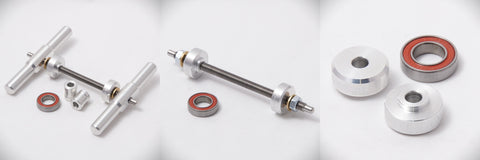
Our tools can be selected either by the bearing's dimensions or by the bearing's standard reference code.
Standard references take the form of a three to five digit number, such as 688, or 6902 for example. These codes are often provided in the bike's user manuals, or moulded onto the bearing's seal. You might see something like 6902-2RS on the seal. The first digits are the standard reference. The second part (2RS in this case) refers to the seal type and doesn't matter for tool selection.
While the letter & numbers after the baring ref usually refer to the type of seal, you should keep an eye out for the suffix 'E', for example 698-E. This denotes that the inner race of the bearing is extended, which will affect puller and press selection.
Alternatively, tools can be selected by their inside (ID) and outside (OD) diameters and width (W).
Note that each tool is specific to one bearing size and can’t be used on bearings with different dimensions.
If you need any help then please feel free to email us! We usually reply within 1 working day.